PII Handling and Compliance in MLOps

Machine learning pipelines often combine data from multiple systems, such as HR, payroll, and other internal applications.
The problem is that data can contain Personally Identifiable Information (PII) such as names, email addresses, phone numbers, employee IDs, addresses, salary information, or other details that can identify a person.
Using this data directly can create privacy and compliance risks.
This is where PII Handling and Compliance becomes important.
What are PII Handling and Compliance?
PII Handling and Compliance is about protecting personal information and making sure that data is processed according to privacy and security requirements.
Before using data for analytics or machine learning, you need to identify personal information and decide what to remove or mask.
This includes collecting only necessary data, restricting access to sensitive fields, and deleting information when it is no longer needed.
These practices align with GDPR principles such as data minimization, purpose limitation, storage limitation, and confidentiality.
Also, information that can indirectly identify someone may also be considered personal data.
PII Handling in Machine Learning Pipelines
PII handling is important in machine learning pipelines that use employee details. ML pipelines may combine data from several internal systems such as HR, payroll, and internal business systems.
And. the data may contain employee names, salary information, and contact details. Before the data reaches model training, personal and sensitive fields need to be identified and handled appropriately.
A typical workflow could look like:
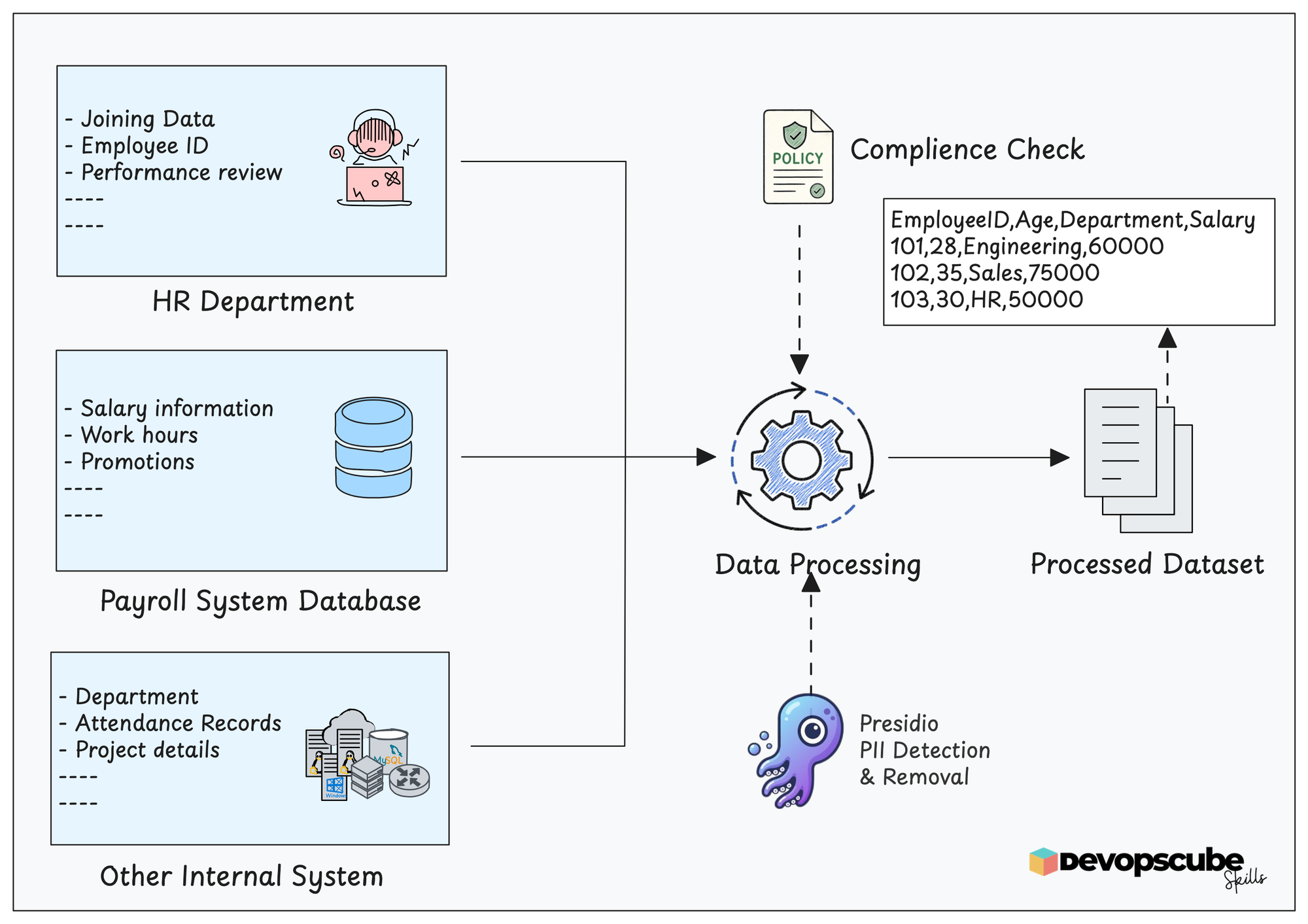
Fields such as names, email addresses, or phone numbers can be removed when they are not required for the ML task.
Another approach is pseudonymization, where directly identifying information is replaced with an identifier.
For example, an employee name could be replaced with a newly generated ID such as EMP-10234. The mapping between the ID and the employee's identity is stored separately with restricted access.
This reduces the risk of direct identification while allowing records to be linked when necessary.
This reduces direct identification, but some pseudonymized data can still be considered personal data if the person can be identified.
The goal is to keep enough information for the ML use case without exposing unnecessary personal details.
PII Compliance in ML Pipelines
PII handling is only one part of compliance.
Even after personal identifiers are removed or masked, organizations must ensure that the remaining data is used for an authorized purpose.
For example, employee information collected for payroll processing cannot automatically be reused for ML model training. The organization must verify that the new use is permitted under applicable privacy requirements.
Compliance also involves controlling who can access the data, where it is stored, how long it is retained, and whether appropriate security measures are in place.
These protections should apply throughout the ML pipeline, including raw datasets, processing logs, training datasets, stored model artifacts, and model outputs that may contain or reveal personal information.
Privacy regulations such as GDPR and India's DPDP Act set requirements for protecting personal data. ML pipelines must follow the applicable rules when collecting, processing, storing, and using personal information.
In summary, PII handling and compliance help ensure that ML pipelines use only the necessary data while protecting individuals privacy throughout the data lifecycle.